
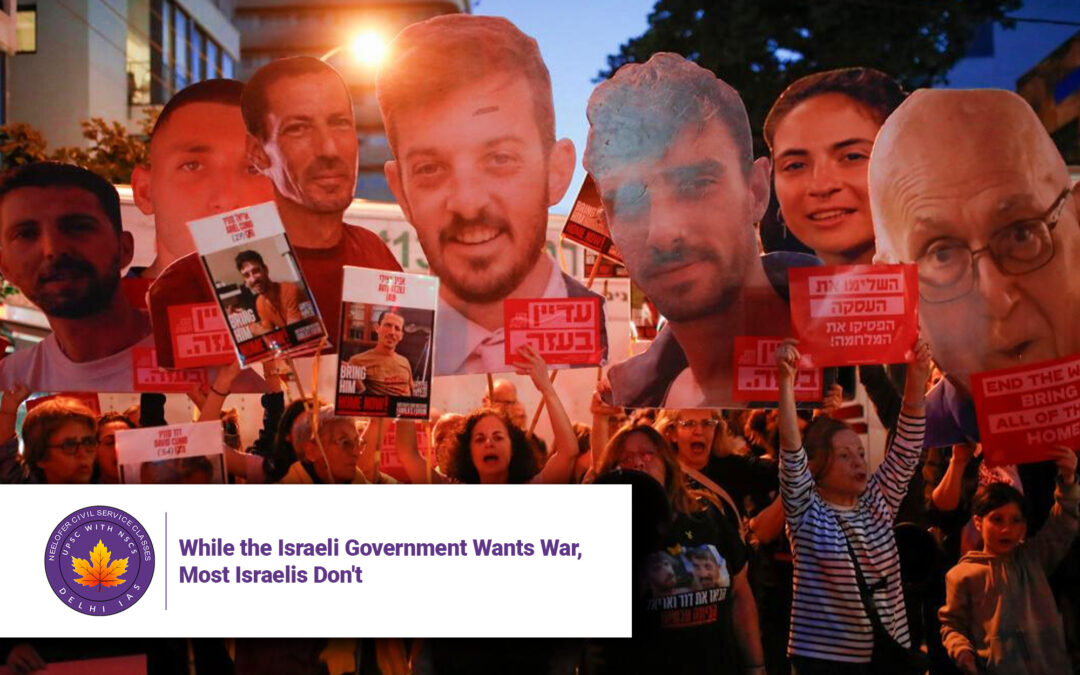
While the Israeli Government Wants War, Most Israelis Don’t
Surveys Reveal Public Concern Over War, Economy, and Democratic Integrity
Why in News?
Israel’s recently passed budget and its ongoing war with Hamas have sparked domestic unrest, with surveys suggesting a sharp divide between government actions and public sentiment. A majority of Israelis are expressing concern about the war’s economic impact and are calling for purposeful negotiations instead. 
Introduction
After Israel passed its contentious budget, Finance Minister Bezalel Smotrich termed it a “war budget and a victory budget.” However, public opinion tells a different story. Surveys from the Israel Democracy Institute reveal that a majority of Israelis neither support the war narrative nor share the government’s optimism.
Key Issues
1. War and Public Sentiment
Since Hamas’s attack on October 7, 2023, Israel has launched over 35,000 attacks, with 18,000+ targeting Palestine, resulting in significant casualties. Despite this aggressive approach, only 44.2% of Israelis believe negotiations with Hamas should continue, while 28.7% think they should stop, and 20.5% are uncertain (Table 2).
2. Budget Priorities and Economic Concerns
Israel’s new budget, passed in early March, allocates a record $23.1 billion for military operations, particularly in Gaza and Lebanon. As a result, the fiscal deficit widened to 8.2% in 2024, the highest since 2020 (Chart 6). Yet, 59% of Israelis expressed pessimism about their country’s economic future (Table 4). The budget is widely seen as serving narrow sectarian interests, with 47.8% of respondents calling for PM Netanyahu’s resignation (Table 3).
3. Public Trust in Governance
Only 22.5% of respondents believe the budget was based on objective economic considerations, while 62.6% believe it serves narrow group interests (Table 5). The public is also increasingly pessimistic about the future of democratic governance, with only 6.5% expressing optimism (Table 4).
Challenges and the Way Forward
The Israeli government faces growing domestic disapproval amid rising economic concerns, war fatigue, and skepticism about democratic integrity. With U.S. support still strong, Israel remains isolated in its internal dissent. The government must reconsider its priorities by balancing national security with economic sustainability and public trust.
Conclusion
As conflict persists and economic pressures mount, the Israeli government’s approach is increasingly at odds with the people’s sentiment. Addressing citizens’ concerns through diplomatic efforts, economic reform, and transparent governance will be crucial to restoring national stability.
Q&A Section
Q1: How do Israelis feel about continuing negotiations with Hamas?
A: According to Table 2, 44.2% of Israelis believe negotiations should continue, while 28.7% oppose it.
Q2: What is the public’s perception of the recently passed Israeli Budget?
A: 62.6% believe the budget favors narrow interests, and only 22.5% see it as objective and economically driven (Table 5).
Q3: How has the war impacted Israel’s fiscal health?
A: Israel’s fiscal deficit rose sharply to 8.2% in 2024, the highest since the pandemic year of 2020 (Chart 6).
Q4: What are Israelis’ views on Prime Minister Netanyahu’s accountability?
A: 47.8% of respondents believe PM Netanyahu should resign due to the events of October 7, 2023 (Table 3).
Q5: How do Israelis feel about their economic and democratic future?
A: Only 6.5% are optimistic about democracy, and just 6.8% are optimistic about the economy post-budget (Table 4).
