
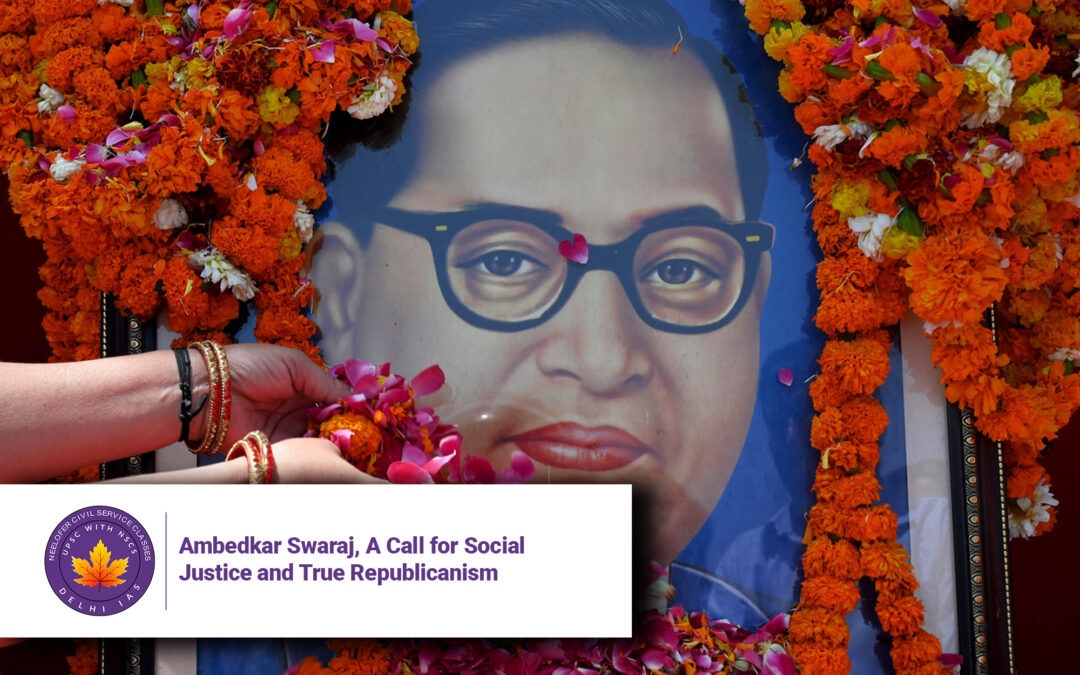
Ambedkar Swaraj, A Call for Social Justice and True Republicanism
Why in News?
April 14 marks the birth anniversary of Dr. B.R. Ambedkar — a visionary leader, social reformer, and the chief architect of the Indian Constitution. His idea of swaraj (self-rule) was deeply rooted not just in political freedom but in social justice and equality, especially for the historically oppressed communities. His vision remains relevant in today’s socio-political landscape. 
Introduction
In popular discourse, Ambedkar is often remembered as a champion of human rights and the Constitution. However, his concept of swaraj went beyond electoral democracy. He envisioned a radical transformation of India’s political and social structures — a genuine republicanism that empowers Dalits, Adivasis, Bahujans, and all marginalized communities.
Key Issues
1. Swaraj as Social Empowerment
Ambedkar’s swaraj wasn’t just about independence from colonial rule; it meant awakening the masses, especially the oppressed, to their social and political servitude. He saw the need for an egalitarian republic — where power structures would be dismantled to ensure social and economic inclusion.
2. Critique of Traditional Social Order
He strongly opposed the Brahmanical and feudal structures that historically controlled Indian society. These systems excluded the majority from power, treating them as inferior. Ambedkar’s vision challenged this by demanding access to equal rights, education, and opportunities for marginalized people.
3. The Role of the State in Justice
Ambedkar believed the State must be an ethical and guardian institution, not just an administrative body. It had a duty to:
-
Address social inequalities,
-
Ensure fair distribution of resources,
-
Promote education, reservations, and welfare policies for Scheduled Castes and Tribes,
-
Break dependency and patron-client relationships.
He emphasized social justice as central to a republic’s functioning, calling for distributive justice that would empower the weakest sections.
4. True Republicanism vs Symbolic Democracy
Ambedkar warned against hollow forms of democracy where elections merely transfer power among elites. True republicanism, to him, meant:
-
Ending the rule of elites,
-
Democratizing all institutions,
-
Allowing marginalized communities to lead and participate in decision-making.
Swaraj was not complete until the historically excluded were able to assert their political will and reshape power structures.
5. The Fight Against Neoliberalism and Elite Capture
In today’s context of neoliberal economic policies, Ambedkar’s concerns are deeply relevant. Elite dominance continues, while Dalits, Adivasis, and OBCs often remain voiceless. Ambedkar’s vision calls for bahujan collectives to push back, redefine the State, and realize true swaraj.
Challenges and the Way Forward
-
Institutional reforms must ensure representation of historically oppressed groups in governance.
-
Democratic spaces must go beyond elections to empower marginalized voices.
-
There’s a need to reimagine swaraj as social transformation, not just political independence.
Conclusion
Ambedkar’s idea of swaraj is not just a memory of the past — it is a radical roadmap for a just, inclusive, and truly republican India. As neoliberalism threatens democratic ideals, his teachings urge us to dismantle elite control and build a society rooted in justice, dignity, and equality.
5 Q&A on Ambedkar’s Vision of Swaraj
Q1: What did Ambedkar mean by ‘Swaraj’?
For Ambedkar, swaraj meant awakening people to their oppression and empowering them to challenge traditional power hierarchies. It went beyond political freedom to include social and economic liberation.
Q2: How did Ambedkar view the role of the State?
He saw the State as a guardian institution, responsible for ensuring justice by uplifting the marginalized through policies like reservations, education, and land reforms.
Q3: What was Ambedkar’s criticism of conventional social order?
Ambedkar critiqued the Brahmanical and feudal order for creating systems of exclusion and privilege. He wanted to dismantle these and create an inclusive society based on equal rights and opportunities.
Q4: How is Ambedkar’s vision relevant today?
In today’s era of elite-driven neoliberal policies, marginalized groups still lack representation and resources. Ambedkar’s call for bahujan unity and social justice remains crucial to combat inequality.
Q5: What is the ideal of republicanism according to Ambedkar?
Republicanism, for Ambedkar, meant organizing the people collectively to challenge domination and democratize power — not just symbolic elections but real participation of the oppressed in governance.
