
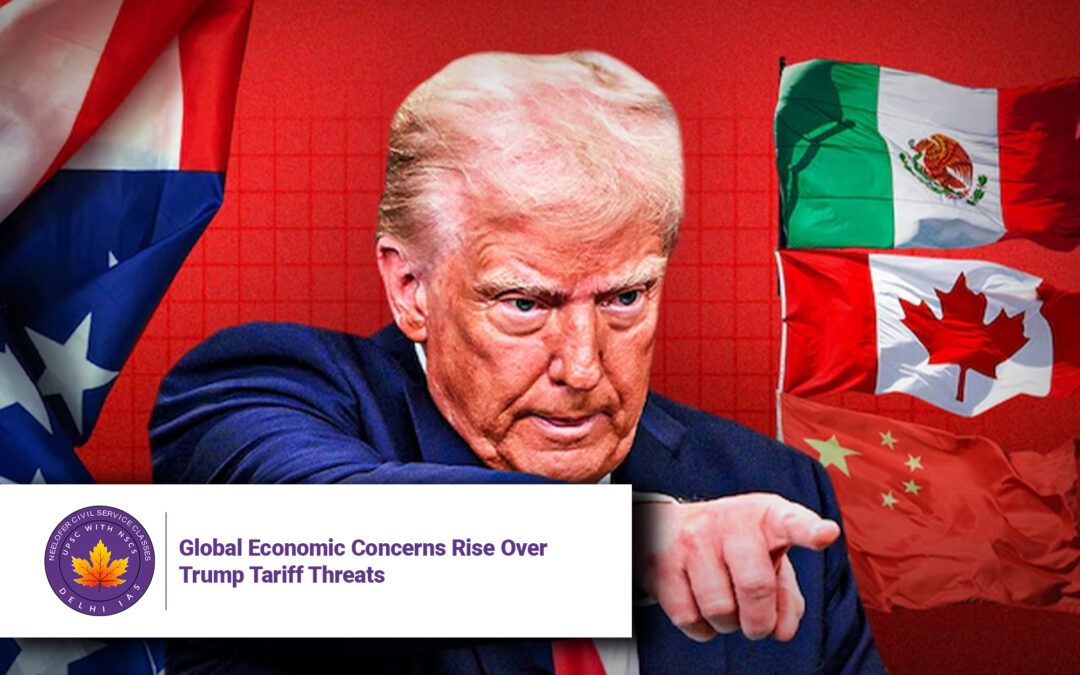
Global Economic Concerns Rise Over Trump Tariff Threats
Why in News?
Former U.S. President Donald Trump’s renewed focus on tariffs as a campaign agenda ahead of the 2024 presidential elections has drawn sharp criticism from global leaders and economists. His pause and potential re-imposition of tariffs announced on April 2, 2025, could destabilize the global economy, with direct implications for countries like India, Canada, and the EU. 
Introduction
Donald Trump has turned the word “tariff” into a verb, using it as a political and economic weapon. With a proposed wave of stiff tariffs targeting imports into the U.S., Trump aims to reinforce his ‘Make America Great Again’ (MAGA) doctrine. However, many warn that this strategy could harm not just the U.S., but the entire world economy.
Key Issues and Background
1. Seven-State Obsession
Trump’s economic strategy is largely influenced by seven key swing states – Arizona, Georgia, Michigan, Nevada, North Carolina, Pennsylvania, and Wisconsin – which helped him win the presidency. These regions are characterized by deindustrialization, high unemployment, and white male industrial workers’ concerns. His tariff policies aim to win their favor.
2. Simplistic Tariff Formula
On April 2, 2025, Trump unveiled a tariff table where the rate is half the trade deficit with a country, divided by the value of goods the U.S. exports to that country. Critics argue this is economically flawed and dangerously simplistic.
3. Impact on Trade and Services
Experts predict that trade in goods and services will suffer, especially sectors like immigration, capital flows, and talent movement. The supply chains may face serious disruptions, leading to inflation and job losses.
The Core of the Concern
1. Global Pushback
Canada, Europe, and China have responded with resilience. China is firm on retaliatory tariffs, and the European Union and other leaders have criticized Trump’s unilateralism. India has yet to comment officially, but is urged to form a trade coalition with allies and push back diplomatically.
2. U.S. Public Backlash
The average American consumer is likely to suffer from price hikes, job losses, and economic instability. There are already signs of public protests and inflation, with many Americans seeing through Trump’s economically damaging strategy.
Key Observations
-
The pause on tariffs gave a brief hope of economic rationality, but if re-imposed, they could trigger a global recession.
-
Trump’s focus on populism over facts is seen as a delusional economic strategy.
-
India, among other nations, needs to actively engage in global trade and not remain passive.
Conclusion
Trump’s tariff strategy may appeal to a narrow political base, but it holds dangerous consequences for the global economic order. With warnings from economists, governments, and trade experts, the world must prepare for turbulent times if the U.S. under Trump resumes an aggressive tariff policy. Ultimately, economics, not slogans, will determine the outcome—and India must stand with economic logic, not populist missteps.
Q&A Section
Q1. What are Trump’s new tariff plans based on?
Trump’s plan is to impose tariffs calculated as half of the U.S. trade deficit with a country divided by the value of U.S. exports to that country.
Q2. Why is Trump focusing on seven specific U.S. states?
These swing states were crucial in his previous election win and are suffering from deindustrialization and economic anxiety, which he tries to address with nationalist policies like tariffs.
Q3. How could this affect India?
India may face a mix of recession, inflation, reduced exports, and lower foreign investment if Trump re-imposes tariffs. India needs to align with global allies to safeguard its economy.
Q4. What global reactions have been observed?
Countries like Canada, China, and the EU are resisting Trump’s tariff threats. China has warned of counter-tariffs, while others continue pushing for open trade.
Q5. What is the biggest concern for the world economy?
A renewed tariff war could disrupt supply chains, limit capital and talent movement, and spark a global recession driven by inflation and trade slowdowns.
