
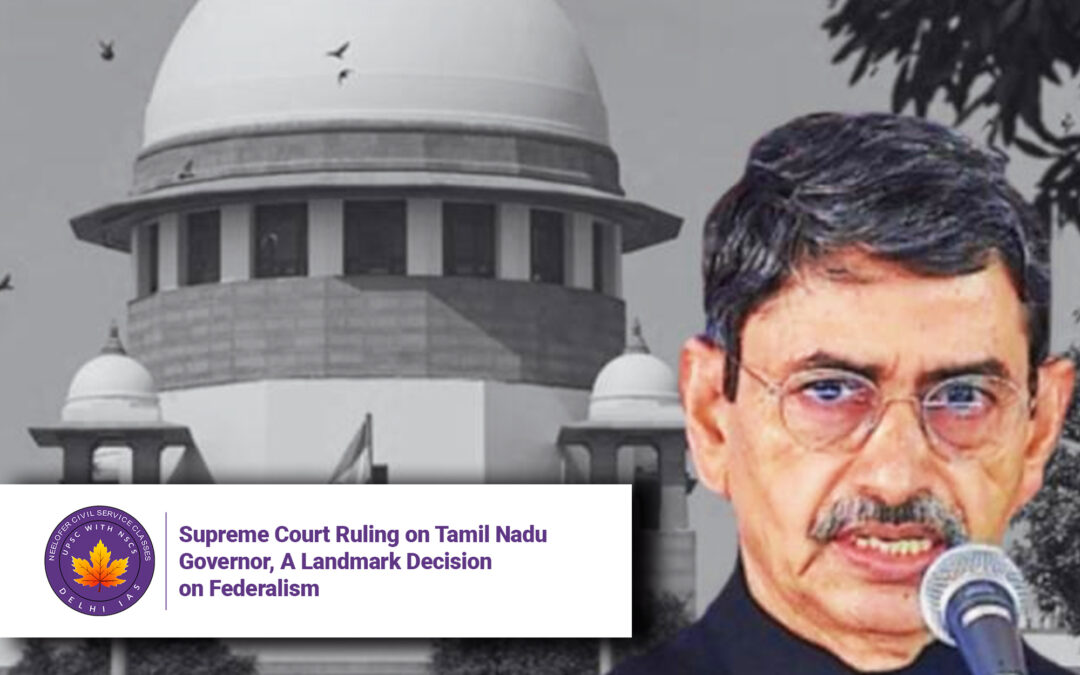
Supreme Court Ruling on Tamil Nadu Governor, A Landmark Decision on Federalism
Why in News?
On April 8, 2024, the Supreme Court of India declared the Tamil Nadu Governor R.N. Ravi’s refusal to grant assent to 10 Bills passed by the State legislature as illegal and unconstitutional. The verdict emphasized cooperative federalism and offered constitutional remedies to Opposition-ruled States. 
Introduction
This historic judgment by Justices J.B. Pardiwala and R. Mahadevan is a significant development in Centre-State relations. It addresses the misuse of the Governor’s office to delay or deny assent to legislation passed by elected state governments—especially in Opposition-ruled states.
Key Issues and Background
1. Governor’s Powers under Article 200
-
Article 200 allows a Governor to:
-
Grant assent
-
Withhold assent
-
Reserve the Bill for the President
-
Return the Bill to the Assembly for reconsideration
-
-
Exception: Money Bills must be granted assent.
2. Misuse of Pocket Veto
-
Governors have delayed Bills indefinitely without formally rejecting or acting on them—known as the “pocket veto”.
-
The Court ruled that this delay violates Article 200, which mandates timely action.
The Core of the Concern
1. Strict Timelines for Governor
-
If a Governor decides to withhold assent, the Bill must be returned “as soon as possible”.
-
If the legislature passes the Bill again with or without amendments, the Governor is constitutionally bound to grant assent within one month—unless reasonable grounds exist.
2. Clarification on Presidential Referral
-
The Governor can only refer a Bill to the President if it has been substantially altered and is not materially the same as originally passed.
-
Personal dissatisfaction or political motives cannot justify delays.
Key Observations
-
The term “shall” in Article 200 signifies mandatory action.
-
The Court criticized equating “withholding assent” with a power to veto, emphasizing that such interpretations harm parliamentary democracy.
-
The Court also limited Presidential discretion, stating delays must be justified and documented.
Conclusion
The SC ruling is a powerful reaffirmation of cooperative federalism. It prevents political misuse of constitutional offices and empowers State governments by clearly defining timelines and duties of Governors and the President in legislative matters. This is a vital step toward balancing power between the Union and State governments. 
📺 Watch a detailed explanation here: https://www.youtube.com/watch?v=D9RZ-MhkvlY
Q&A Section
Q1. What did the Supreme Court say about the Governor’s delay in assenting Bills?
The Court called it illegal and unconstitutional, stating Governors must act within defined timelines and cannot sit indefinitely on Bills.
Q2. Can the Governor reject a Bill after it is passed a second time by the State Assembly?
No. The Governor is obligated to grant assent unless there are reasonable grounds, and this must happen within one month.
Q3. What is the “pocket veto” and what did the Court say about it?
The pocket veto is when a Governor delays action on a Bill without rejecting or returning it. The Court ruled this practice is not allowed under the Constitution.
Q4. What happens if the Governor refers a Bill to the President?
The Bill must be materially different from the original. Political reasons like dissatisfaction or expediency are not valid justifications.
Q5. What broader impact does this ruling have?
It protects the federal structure, limits the arbitrary use of powers by Governors, and offers a constitutional remedy to states facing legislative blockages.
