
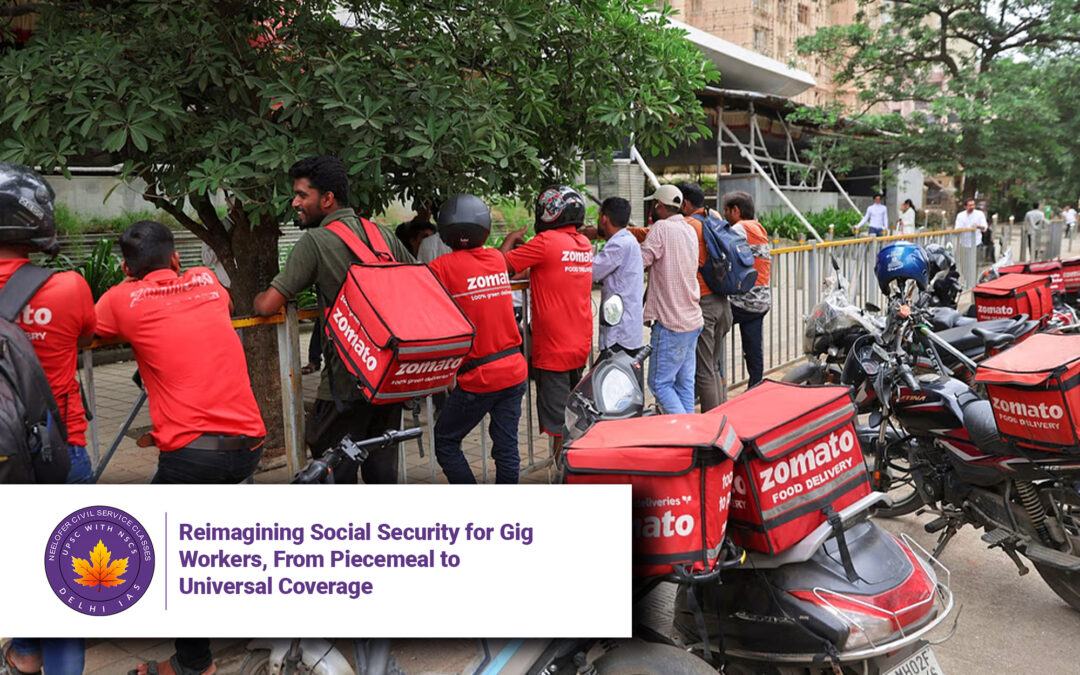
Reimagining Social Security for Gig Workers, From Piecemeal to Universal Coverage
Why in News?
India’s central government is set to roll out a comprehensive social security scheme for app-based gig workers, with Cabinet approval underway. While this marks progress, experts argue that piecemeal solutions are insufficient, urging a shift toward universal social protection frameworks. 
Introduction
With the rise of platform-based employment in India, ensuring adequate social protection for gig workers is no longer optional—it’s essential. A new central scheme promises benefits such as Ayushman Bharat health coverage, registration on the eShram portal, and a transaction-based pension system. But experts caution that India’s approach remains reactive and fragmented, responding to worker needs only after new categories emerge.
Key Issues / Background
1. Progress for Gig Workers
The new scheme includes a pension model that assigns a universal account number to each gig worker, allowing for cross-platform tracking of earnings and contributions. This acknowledges the unique nature of gig work where one worker may have multiple employers.
2. Structural Weaknesses in Current Social Protection
Despite being a founding member of the ILO and ratifying the Social Security Convention (1952), India’s current social security systems largely exclude informal and gig workers. This reveals a critical gap in inclusive policy design.
3. Challenges with Welfare Boards
India’s Code on Social Security (2020) leans on welfare boards to manage benefit distribution. However, multiple RTI and CAG reports have exposed widespread inefficiencies. For example:
-
₹70,744.16 crore in cess for construction workers remains unutilized.
-
99 local bodies in Tamil Nadu delayed payments worth ₹221.8 crore.
-
Only 5 out of 16 welfare boards in Kerala were found functioning effectively.
4. The Problem with Incremental Approaches
Targeted relief models, though useful in some contexts (e.g., for bidi or construction workers), are inadequate for today’s evolving workforce. They create artificial divides among informal workers (e.g., gig vs domestic work), introducing arbitrary thresholds for entitlement.
5. The Case for Universal Protection
Instead of fragmenting support based on worker category, a robust, flexible, and inclusive system that can evolve with workforce changes is necessary. Treating the Social Security Code’s mandates as a floor—not a ceiling—can help build a more future-ready, resilient system.
5 Key Observations
-
India’s gig workers are finally receiving formal social protection recognition, but implementation lags remain.
-
Welfare boards have failed to efficiently disburse funds, eroding trust and impact.
-
Gig work’s multi-employer nature demands systems that go beyond traditional employment definitions.
-
Piecemeal social welfare targeting specific groups may leave large informal segments behind.
-
Universal, inclusive systems based on the Social Security Code could offer a long-term solution—if strengthened and enforced.
Conclusion
India stands at a crucial juncture in redefining social protection. While recent schemes for gig workers are promising, relying on fragmented welfare systems and reactive approaches undermines long-term stability. The need of the hour is to create a universal framework that is inclusive, adaptive, and leaves no worker behind—be it gig, domestic, or informal.
Q&A Section
Q1. What recent initiative has the Indian government proposed for gig workers?
A national social security scheme is being introduced that offers Ayushman Bharat coverage, eShram portal registration, and a pension model with a universal account number to track earnings across platforms.
Q2. Why are current social protection frameworks inadequate?
They are often reactive and fragmented, responding to new worker types only after they emerge. Additionally, they tend to exclude informal and gig workers and rely heavily on inefficient welfare boards.
Q3. What issues have been reported with existing welfare boards?
Multiple boards across states have failed to disburse collected funds, delayed payments, and reported no active beneficiaries. For example, Tamil Nadu’s board delayed ₹221.8 crore in payments, and several Kerala boards were non-functional.
Q4. Why is a piecemeal approach risky?
It can create arbitrary divisions between informal worker types and fails to account for the precarious and shifting nature of gig and informal employment.
Q5. What is the recommended way forward for India’s social protection system?
India should treat the current Code on Social Security as a foundation, aiming to build a comprehensive, inclusive, and resilient system that addresses all forms of informal labor through universal protection.
