
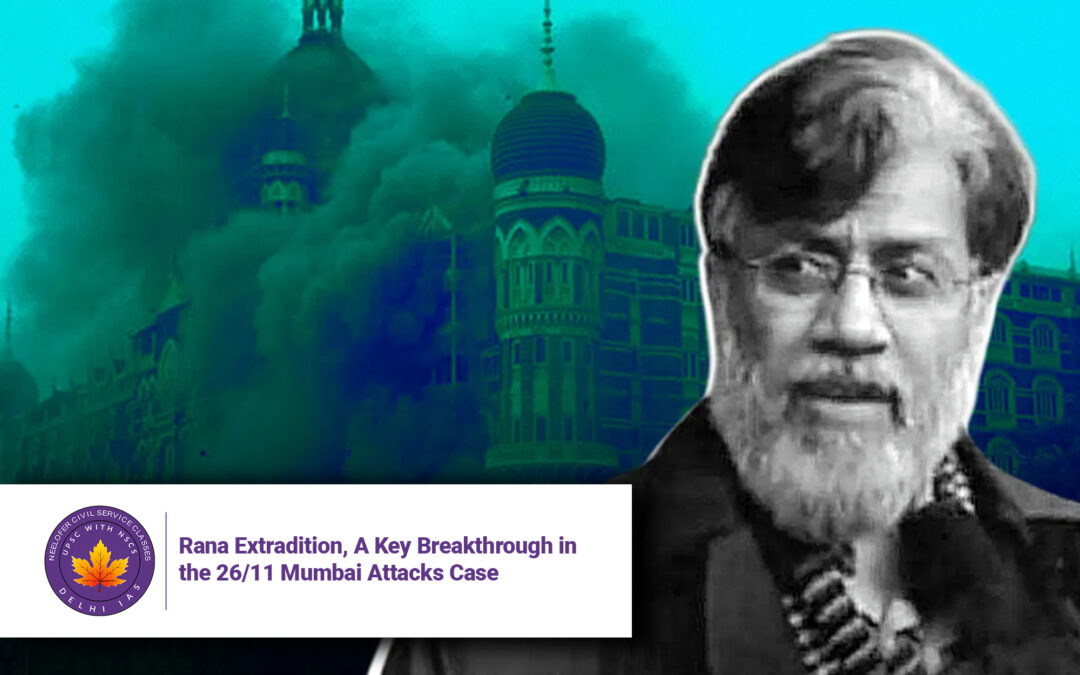
Rana Extradition, A Key Breakthrough in the 26/11 Mumbai Attacks Case
Why in News?
Seventeen years after the deadly 26/11 Mumbai terror attacks, the extradition of Tahawwur Hussain Rana to India from the United States has been completed. His trial marks a crucial moment in India’s continued pursuit of justice for one of the most heinous terror strikes in its history. 
Introduction
The 26/11 attacks in 2008 left 166 people dead and shocked the world. While Ajmal Kasab was caught alive and later executed, several key conspirators remained beyond India’s reach. Now, the extradition of Tahawwur Hussain Rana—a Pakistani-origin Canadian-American and an alleged co-conspirator—opens a new chapter in India’s quest to hold all perpetrators accountable. His handover by the U.S. underscores India’s diplomatic persistence and expands the scope for deeper probes into cross-border terrorism.
Key Issues / Background
1. Rana’s Role in the Conspiracy
Rana, a childhood friend of David Headley (the LeT operative who conducted the reconnaissance for the Mumbai attacks), allegedly facilitated Headley’s entry into India and helped plan the strikes. He was also linked to a failed plan to attack a newspaper office in Copenhagen.
2. Legal Journey and U.S. Conviction
Although not convicted for the Mumbai attacks in his U.S. trial, Rana was found guilty of conspiracy related to the Copenhagen plot and LeT links. He served part of a 14-year sentence in the U.S.
3. India’s Legal Strategy and the Extradition’s Importance
Rana was charge-sheeted in absentia for the 26/11 attacks. His extradition allows Indian prosecutors to finally bring him to trial and dig deeper into his Pakistani links, including his ties with the military establishment and LeT.
4. Lingering Questions and Need for Investigation
India must now investigate unresolved aspects such as:
-
Rana’s possible ongoing links with Pakistan’s military,
-
U.S. decisions to offer immunity to David Headley under a plea bargain,
-
And the failure of U.S. intelligence to alert India before Headley’s return to conduct reconnaissance again in 2009.
5. Broader Geopolitical Implications
Rana’s trial may re-ignite international focus on Pakistan’s role in harboring and facilitating terror actors. India hopes this will lead to renewed pressure on Pakistan to prosecute other LeT commanders including Hafiz Saeed.
The Core of the Controversy: Diplomatic Gaps and Hidden Networks
While Rana’s extradition is a win for Indian diplomacy, the article highlights the puzzling leniency towards Headley, despite his deeper involvement. The U.S. had prior intel on Headley’s activities but failed to warn India, raising questions of trust in counter-terror partnerships. Rana’s case may also help trace the operational and financial web of Lashkar-e-Taiba with institutional backing.
Missed Perspectives
-
Justice delayed still demands a full trial and closure.
-
Extraditions can serve strategic pressure points in diplomacy.
-
The U.S.-India intelligence gap must be reviewed.
-
Rana’s links to Pakistani institutions may expose deeper complicity.
-
It’s a reminder that cross-border terrorism thrives on global complacency.
Conclusion
Tahawwur Rana’s extradition is a critical step toward long-overdue justice. Beyond the courtroom, it serves as a symbolic victory against impunity and terror networks. It also reasserts India’s resolve to ensure that no actor involved in 26/11—regardless of geography—escapes trial. This extradition could reignite international pressure on Pakistan to finally act against other key conspirators still at large.
Q&A Section
Q1. Who is Tahawwur Hussain Rana and what is his connection to the 26/11 attacks?
Rana is a Canadian-American citizen of Pakistani origin and a childhood friend of David Headley. He is accused of helping plan the Mumbai attacks by facilitating Headley’s movements and serving as a key enabler in the Lashkar-e-Taiba (LeT) network.
Q2. Why is his extradition from the U.S. significant?
Rana was charge-sheeted in absentia in India. His extradition enables Indian courts to try him on Indian soil, explore his Pakistani links, and seek broader justice for the 26/11 victims.
Q3. Was he convicted in the U.S. for the Mumbai attacks?
No. He was convicted in the U.S. for his involvement in the LeT-linked Copenhagen conspiracy but not for the Mumbai attacks. However, U.S. prosecutors confirmed his role in facilitating them.
Q4. What are the questions India needs to investigate now?
India must probe whether Rana maintained links with Pakistan’s military, examine the extent of Pakistani state complicity, and understand why the U.S. gave Headley immunity despite a treaty with India.
Q5. What broader impact could Rana’s trial have?
It could reignite global scrutiny on Pakistan’s support for terror actors and generate pressure for action against other conspirators like Hafiz Saeed. It also offers a path to closure for the victims’ families and strengthens India’s counter-terror narrative.
