
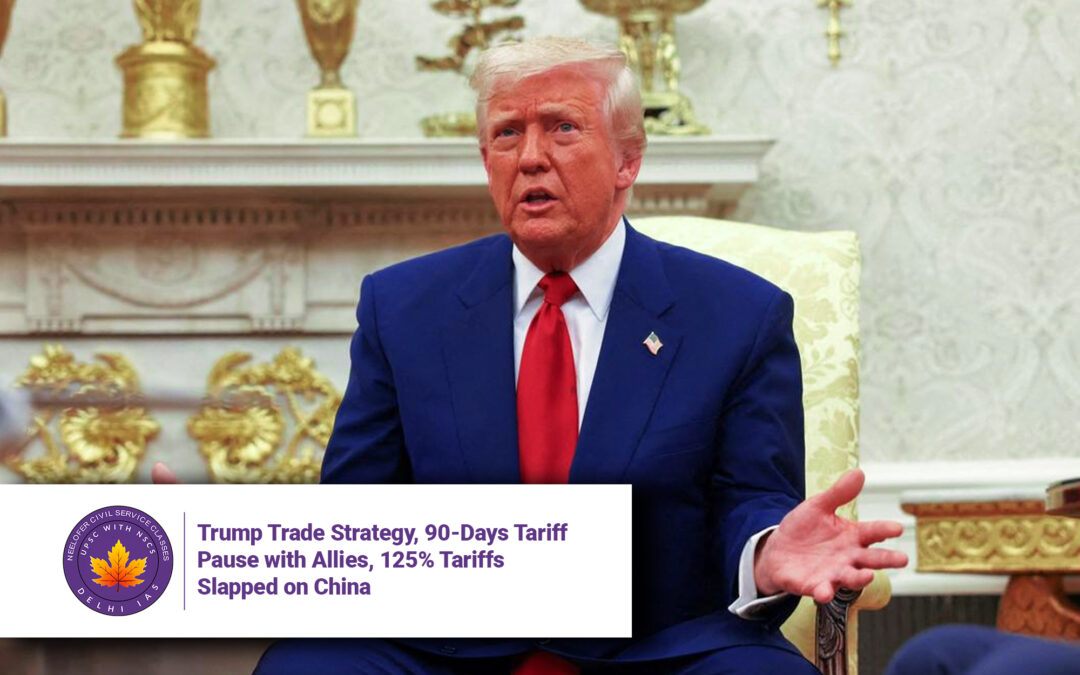
Trump Trade Strategy, 90-Days Tariff Pause with Allies, 125% Tariffs Slapped on China
Why in News?
In a major shift in the ongoing global trade war, U.S. President Donald Trump has announced a 90-day pause on tariffs for most countries. However, the U.S. simultaneously raised tariffs on Chinese goods to a sharp 125%, escalating tensions between the world’s two largest economies. 
Introduction
The announcement came as a surprise reversal from Trump’s earlier aggressive tariff stance. It reflects a dual-track strategy—easing pressures on global allies while tightening trade barriers against China, which Trump accuses of “ripping off” the United States.
Key Issues and Background
1. 90-Day Pause for Most Countries
-
Trump authorized a 90-day tariff pause, maintaining a flat 10% tariff on all countries.
-
This move came after over 75 countries reached out to negotiate and did not retaliate against U.S. tariffs.
2. 125% Tariff on Chinese Goods
-
Just hours after increasing tariffs on Chinese goods from 104% to 125%, Trump made the announcement via social media.
-
Trump stated the action was due to China’s “lack of respect” and retaliatory tariffs.
3. China’s Response
-
China had already retaliated earlier by raising tariffs on U.S. imports to 84%.
-
Trump’s additional increase appears to be a response to China’s retaliatory stance.
The Core of the Concern
1. Escalation with China
-
This tariff hike marks a deepening of the U.S.-China trade confrontation.
-
Trump asserted that China’s actions were no longer “sustainable or acceptable.”
2. European Union’s Reaction
-
The EU announced €20 billion in countermeasures, targeting U.S. products like soybeans, motorcycles, and cosmetics.
-
This was in retaliation for American tariffs on steel and aluminium exports.
Key Observations
-
Wall Street experienced sharp market volatility following Trump’s sudden tariff moves.
-
The pause is seen as a diplomatic gesture to allies, while the tariff hike on China signals a more aggressive trade posture.
-
Trump aims to pressure China into a new deal by increasing the economic cost of inaction.
Conclusion
President Trump’s decision reflects a tactical shift: a temporary truce with allies and a forceful escalation with China. As the trade war deepens, global markets and international diplomacy are both on edge. Whether this bold move will yield concessions or provoke further retaliation remains to be seen.
Q&A Section
Q1. What is the new tariff rate imposed by the U.S. on Chinese goods?
The U.S. raised tariffs on Chinese goods to 125%, up from 104%.
Q2. Why did Trump pause tariffs for most countries?
Trump said over 75 countries reached out for negotiations and didn’t retaliate, prompting a 90-day pause in increased tariffs.
Q3. How did China retaliate against earlier U.S. tariffs?
China raised tariffs on U.S. imports to 84%, prompting Trump’s more aggressive stance.
Q4. What was the EU’s response to the U.S. trade policy?
The European Union announced €20 billion in tariffs on U.S. goods like motorcycles, soybeans, and cosmetics.
Q5. What effect did the tariff moves have on the financial market?
The announcements triggered stock market turbulence, with Wall Street reacting sharply to the sudden escalation.
