
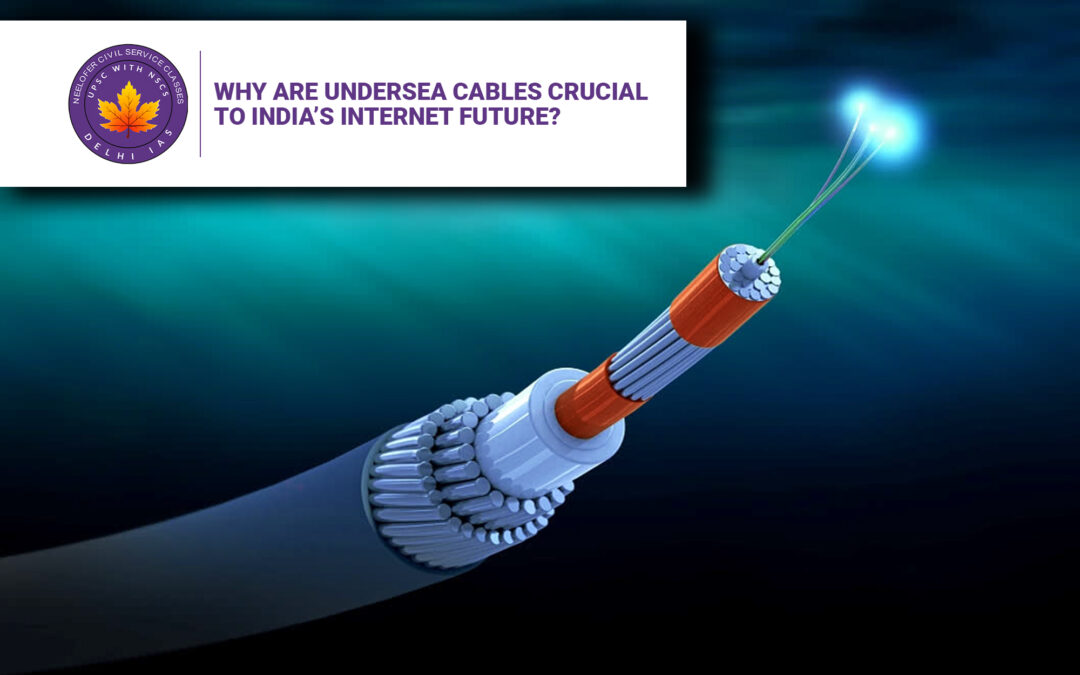
Why Are Undersea Cables Crucial to India’s Internet Future?
Why in News?
India is progressively expanding its undersea cable landing infrastructure, with recent additions such as Airtel’s 2Africa Pearls system. Despite this growth, India’s dependence on a few cable landing sites and regulatory challenges leave its internet ecosystem vulnerable to disruptions. 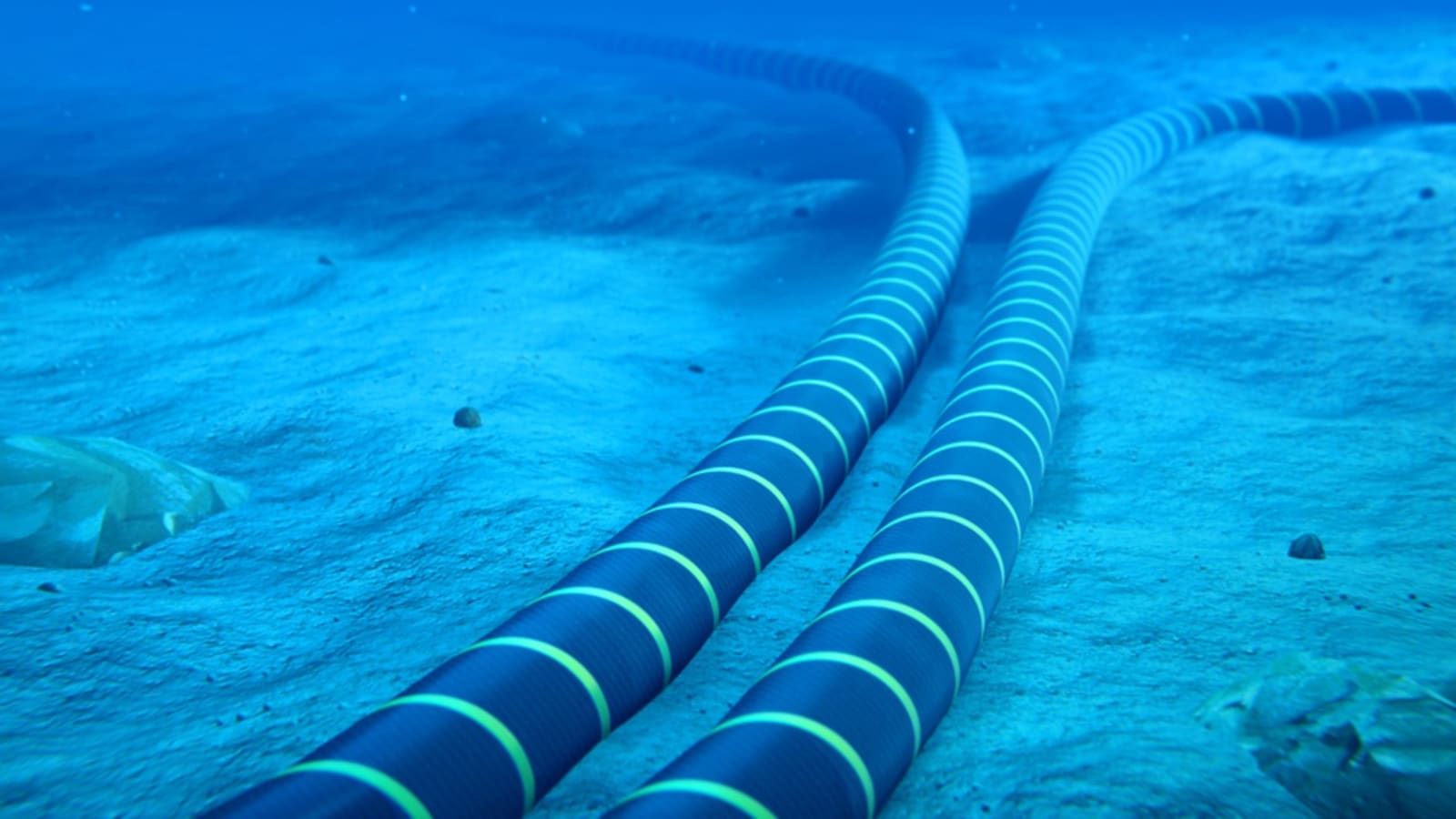
Introduction
Undersea cables form the invisible but essential backbone of global internet infrastructure. They facilitate cross-border data movement, enabling international communications, financial transactions, and streaming services. As India increases its reliance on digital connectivity, bolstering undersea cable infrastructure becomes critical to ensure internet resilience and economic competitiveness.
Key Issues and Background
-
What are Undersea Cables?
Undersea cables are thick fiber optic strands laid on the ocean floor, designed to withstand extreme environments. They connect telecom providers across countries, enabling high-speed data transfer. These cables carry more than 95% of international data, powering everything from online banking to cloud services. -
India’s Current Undersea Cable Landscape
India has 17 undersea cable systems, most of which land in Mumbai and Chennai. These cities act as major digital gateways, handling around 95% of the country’s subsea data. Other cable landings exist in the Andaman and Nicobar Islands and Gujarat. Airtel’s latest 2Africa Pearls system adds significant bandwidth, connecting India to the global network. -
Why Is India Vulnerable?
India’s reliance on just two major landing sites makes it susceptible to outages. For instance, disruptions in the Red Sea could jeopardize connectivity for many countries. Additionally, India’s share in global cable infrastructure remains low compared to its digital consumption. -
Challenges in Cable Laying
India’s submarine cable expansion is slowed by regulatory bottlenecks. Laying cables involves getting over 15 permissions from various departments like the Home Ministry, Defence, Environment, and local municipalities. Experts criticize this as a major deterrent for global companies. -
Efforts and the Way Forward
To address vulnerabilities, India needs to streamline approval processes and invest in regional diversity. Experts advocate decentralizing cable landings beyond Mumbai and Chennai, promoting hubs in coastal states, and allocating dedicated zones for undersea infrastructure.
The Core of the Concern
India’s digital economy depends heavily on seamless global data access. With increasing pressure from AI, cloud services, and digital payments, even minor disruptions to cable systems can cause significant downtime. Over-centralization and policy delays further aggravate this risk. Global companies now weigh the ease of doing business when choosing landing sites — and India must compete effectively.
Key Observations
-
95% of subsea data enters India through Mumbai and Chennai.
-
Over 80% of global internet traffic runs through undersea cables.
-
15+ clearances are required in India to lay a single cable — a regulatory burden.
-
Experts fear cable breaks in high-risk regions like the Red Sea could cripple connectivity.
-
New systems like 2Africa Pearls are helping, but India needs broader infrastructure reforms.
Conclusion
For India to maintain its momentum as a digital powerhouse, expanding and securing undersea cable infrastructure is imperative. Reducing bureaucratic hurdles, diversifying landing locations, and embracing technological upgrades will be vital steps toward building a more resilient and future-ready internet backbone.
Q&A Section
Q1. What are undersea cables and why are they important?
Undersea cables are fiber optic lines laid on the ocean floor that connect global internet networks. They carry more than 95% of international data, making them essential for the internet, cloud services, and financial systems.
Q2. How many undersea cable systems does India currently have?
India has 17 undersea cable systems, with major landing hubs in Mumbai and Chennai, and minor ones in Gujarat and the Andaman & Nicobar Islands.
Q3. Why is India considered vulnerable to undersea cable disruptions?
India’s heavy reliance on two cable landing stations makes it exposed to outages. Events like cable damage in the Red Sea can severely impact connectivity due to limited rerouting options.
Q4. What are the major challenges in laying cables in India?
Companies face delays due to the need for over 15 permissions from multiple ministries and local authorities, making the process cumbersome and unattractive for global investors.
Q5. What can be done to improve India’s undersea cable infrastructure?
India must streamline regulatory procedures, diversify landing sites beyond Mumbai and Chennai, and incentivize foreign cable projects to improve redundancy and reduce vulnerability.
