
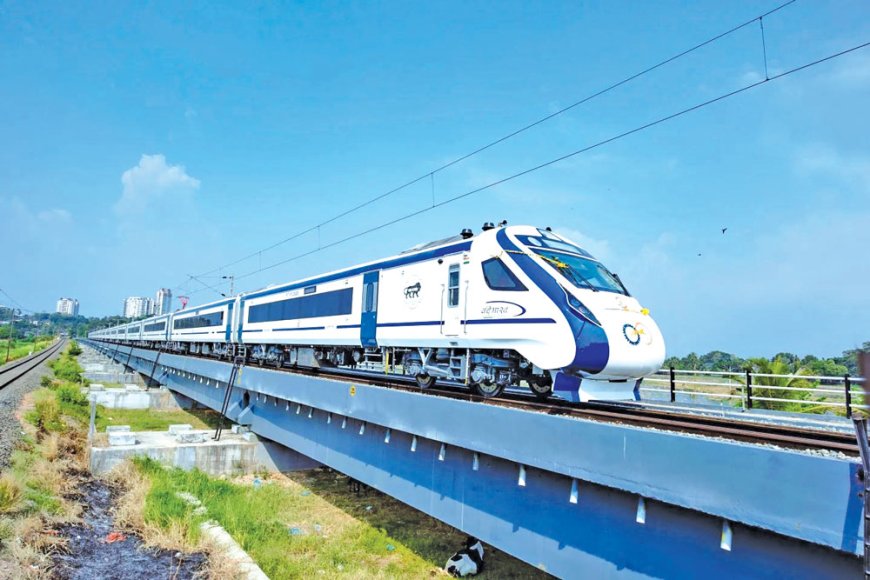
Indian Railways, Engineering India’s Growth Through Strategic Transformation
Why in News?
Indian Railways has emerged as a cornerstone of India’s infrastructure-led growth, achieving record-breaking milestones in modernization, sustainability, and global competitiveness. From hydrogen-powered locomotives to hyperloop ambitions, the national transporter is redefining connectivity while balancing affordability and innovation.
Introduction
Dubbed the “lifeline of the nation,” Indian Railways has undergone a golden decade (2014–2024) of transformation. With strategic investments exceeding ₹25 lakh crore, it has expanded its network, adopted cutting-edge technologies, and positioned itself as a model for emerging economies. This growth aligns with India’s vision of becoming a $8.5 trillion economy, leveraging railways as a catalyst for development. 
Key Achievements
1. Infrastructure Expansion
- Track Network: Added 12,000 km of new lines (2014–2024), doubling electrification to 100% (a global first for major networks).
- Freight Capacity: Surged from 87.3 million tonnes to 1,266 million tonnes, with Dedicated Freight Corridors (DFCs) boosting efficiency.
- Rolling Stock: Locomotive production doubled (4,695 to 9,168 units); coach manufacturing rose by 68% (32,000 to 54,000 units).
2. Technological Leap
- KAVACH System: World’s first automated train collision avoidance system deployed at scale.
- Hydrogen Trains: Set to launch 1,200 HP locomotives (outpowering global prototypes), audited by Germany’s TÜV SÜD.
- Hyperloop Ambitions: Testing 30-km tracks with Swedish and French collaboration, aiming for futuristic transit.
3. Sustainability Leadership
- Net-Zero Pledge: 100% electrification reduces carbon emissions by 30% (2023 data).
- Make in India: 75% domestic content in Bangalore Metro coaches; export orders for West Asia and Russia underway.
4. Financial & Operational Reforms
- Budget Merger: Unified Railway and General Budgets (2017) streamlined funding, enabling focused investments.
- Cross-Subsidy Model: Profitable freight operations subsidize passenger fares, unlike subsidy-dependent Western networks.
Global Partnerships & Projects
- International Connectivity:
- FIRST Initiative: Enhancing rail links with Australia.
- Asia-Africa Corridor: Linking India to Europe via the Middle East.
- Export Hub: Rolling stock and technology exports to Africa, West Asia, and Russia.
Challenges Ahead
- Legacy Issues: Pending projects (₹65 lakh crore required) and maintenance backlog.
- Competition: Rising road/air transport demands continued innovation.
Future Roadmap
- Vande Bharat 2.0: Expand semi-high-speed network.
- Hyperloop Pilot: Complete 30-km test track by 2025.
- Green Hydrogen: Scale hydrogen fuel cell technology for zero-emission transit.
Conclusion
Indian Railways exemplifies how visionary public policy and technological adoption can transform a colonial-era system into a global benchmark. By prioritizing affordability, sustainability, and “Make in India,” it powers not just mobility but also national aspirations. As the writer notes, this journey is “by Bharat, for Bharat”—a testament to inclusive growth.
Q&A Section
Q: What makes Indian Railways unique financially?
A: It cross-subsidizes passenger fares through freight revenues, unlike Western systems reliant on government subsidies.
Q: How is Indian Railways reducing emissions?
A: Via 100% electrification, hydrogen trains, and DFCs cutting freight carbon footprint by 30%.
Q: What are India’s hyperloop plans?
A: Collaborating with Sweden and France to test 30-km tracks, aiming to pioneer next-gen transit.
Q: Which global projects is Indian Railways involved in?
A: FIRST (Australia connectivity), Asia-Africa rail corridor, and rolling stock exports to Russia/West Asia.
— Adapted from commentary by a former Railway Board member and CRF distinguished fellow

